
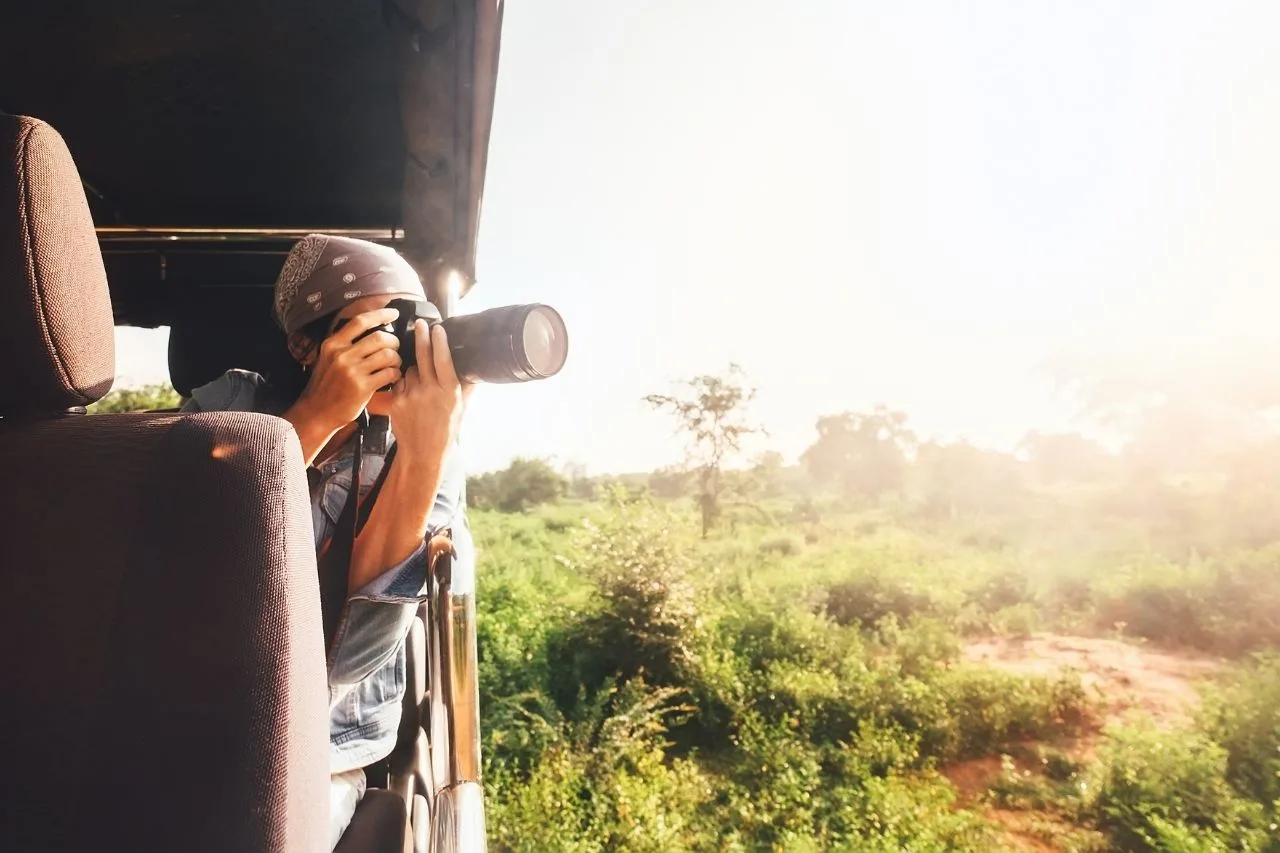
A great safari portfolio is less about carrying everything and more about carrying the right things — gear that fits light-aircraft limits, handles dust and movement, and lets you react fast from a vehicle or boat. This guide gives you a practical, carry-on-friendly kit for African safaris in 2026, plus settings you can trust for wildlife, birds, boats, deserts and starry skies.
What you’re solving for (real-world constraints)
- Weight & size limits on safari hops. Many light aircraft sectors in Southern/East Africa cap luggage around 15–20 kg (33–44 lb) per person, soft bags only, and that total includes your camera kit. Plan your system around that ceiling.
- Dust, speed, and space. You’ll often shoot from a vehicle (shared or private) with quick, hand-held reactions. Stability comes from beanbags and good technique, not bulky tripods.
- Changing light. Expect big contrast: cobalt winter skies, backlit dust, dawn silhouettes, and sometimes moody green-season storms.
- Park rules & ethics. Many parks ban drones outright or require complex permits; flash is discouraged or prohibited; night-drive etiquette matters. Build your plan around those realities.
The carry-on safari kit (by tier)
Minimalist “one-bag” kit (fits strict 15–20 kg trips)
- 1 camera body with strong AF tracking and good high-ISO (any brand, full-frame or APS-C).
- 1 tele-zoom covering the action range — examples by range, not brand: 100–400mm or 200–600mm; on APS-C that’s ~150–600mm equivalent.
- 1 small wide/normal for landscapes, night skies and lodge life: 16–35mm or 24–70mm (f/4 is fine).
- Support: compact beanbag (empty; fill with rice/beans at camp), or a small monopod if you prefer.
- Filters: CPL for glare on water and distant haze; UV/clear only as a sacrificial front element (not for image quality).
- Power & storage: 2–3 batteries, USB-C PD charger, dual 1TB cards or 512GB cards + 1–2 TB SSD for nightly backups.
Ideal enthusiast kit (still carry-on sensible)
- 2 bodies, each with a lens mounted:
- Body A + long zoom (200–600 / 150–600 / 100–400 + 1.4× if AF holds).
- Body B + wide/normal zoom (16–35 / 24–70).
Two bodies mean no lens swaps in dust and instant switch from animal portrait to environment.
- Supplemental prime (optional): a fast 35/1.8 or 50/1.8 for lodge evenings, portraits, and night scenes.
- Accessories: compact binoculars (8×32 or 10×32), blower, sensor swabs (only if you know how), rain/dust covers, and lens cloths.
Pro/photography-first kit (if weight allows)
- 3rd lens to fill gaps: a 70–200/2.8 for low light or a macro (90–105mm) for flowers, reptiles, and textures.
- Travel tripod (hotel & hide use only) — carbon, 3-section, ≤1.4 kg, with a compact ball head. It’s for night skies and lodge terraces, not in vehicles.
- Intervalometer (or built-in) for star stacks and timelapse.
Lenses that cover 95% of safari
- Wildlife “workhorse”: 100–400mm or 200–600mm. These cover eye-level elephants, cats at respectful distances, and most birds. Internal-zoom 200–600 designs balance well and keep dust out; 100–400 options are smaller and pair well with a 1.4× if your AF still tracks confidently.
- Walk-around zoom: 24–70mm (or 24–105mm). Great for vehicles at close range, camp life, portraits of guides, and environmental wildlife frames.
- Wide zoom: 16–35mm. Landscapes (Namibia dunes, Kalahari skies), astro, and tight vehicle interiors.
- Macro (optional): 90–105mm for details — chameleon skin, acacia thorns, footprints, textures at camp.
Crop vs full-frame? APS-C gives you helpful “reach” for small subjects (a 100–400 behaves like ~150–600), while full-frame gives cleaner high-ISO and broader dynamic range. Both can produce outstanding results — prioritize AF tracking, buffer depth, and stabilization over sensor size debates.
Supports & stability (what actually works on safari)
- Beanbag on the door or roof rail is king in vehicles. It’s fast, quiet, and stable — and it doesn’t monopolize space. Fill it at camp to save weight.
- Monopod can help with heavy glass if your vehicle layout allows; it’s more useful on boats and in hides than in cramped rows.
- Tripods are rarely practical in vehicles (they get in the way and are often not allowed). Keep a small one for lodge decks, the stars, or static hide work.
- Straps vs. slings. A simple cross-body or wrist strap with a quick-release plate is safer in the vehicle than dangling harnesses.
Packing & protection
- Carry cameras and lenses in a soft, airline-legal backpack; keep hard cases at home (light aircraft baggage pods are tiny and curved).
- Dust strategy: Two bodies cut lens swaps. If you must swap, do it engine off, lens mount down, and use a blower before and after. A simple pillowcase/dust sack around a mounted body + lens is an excellent quick cover between sightings.
- Power: Southern Africa and most East African countries run 220–230V, 50 Hz. South Africa increasingly uses the Type N (SANS 164-2) socket alongside older Type M; Botswana often uses D/G/M; Namibia D/M; Zambia C/D/G; Zimbabwe D/G. A compact universal adapter plus a USB-C PD charger keeps you light.
- Data safety: Shoot redundant (to two cards) if your camera allows. Each evening, back up to an SSD and keep it separate from the camera bag.
Drones (short answer: usually no)
For most national parks and transfrontier areas in South Africa, Tanzania, and many other countries, drones are prohibited without pre-approved permits from both aviation and park authorities. Even where civil aviation allows hobby operations (e.g., by registration), park rules override and typically ban them to protect wildlife and visitor experience. Plan to leave the drone at home for core safari days; if you’re producing commissioned work, begin the multi-agency permit process months in advance and expect restrictions near wildlife, crossings, and airstrips.
Field-tested settings (cheat sheets you can trust)
These are starting points; adjust for light, animal speed, and background. The goal is nailing the moment in-camera with minimal fiddling.
1) General game drive (mammals on the move)
- Mode: Manual or Shutter-priority
- Shutter: 1/1000 s baseline for walking/grazing; up to 1/1600 s for trotting.
- Aperture: f/5.6–f/8 (balance subject isolation and lens sharpness).
- ISO: Auto ISO with a ceiling you trust (e.g., 6400 on modern sensors).
- AF: Continuous (AF-C), subject/animal tracking, wide/zone area.
- Stabilization: On; use panning/Mode 2 when tracking sideways movement.
- Tip: If backgrounds are bright (sand, sky), dial +0.3 to +0.7 EV to hold animal tone.
2) Birds in flight (BIF)
- Shutter: 1/2000–1/3200 s (smaller, faster birds at the higher end).
- Aperture: f/5.6–f/7.1 to give AF some depth.
- ISO: Auto; expect ISO 1600–6400 at dawn/dusk.
- AF: Continuous with expand/zone, high-speed bursts; pre-focus at expected distance.
- Tip: Practice tracking on ibis, doves, or bee-eaters; keep elbows anchored on the beanbag for stability.
3) Boat photography (Chobe, Lower Zambezi, Okavango channels)
- Shutter: 1/1600 s for moving subjects; 1/1000 s for slower elephants/hippos.
- Polarizer: Use a CPL sparingly to cut glare — but remember it costs you light (often ~1–1.5 stops).
- Stabilization: On; short bursts to counter boat bob.
- Tip: Keep horizons level; sit low for eye-level wildlife and reflections.
4) Golden backlight & dust (late dry season)
- Shutter: 1/2000 s to hold sparkly dust;
- Aperture: f/4–f/5.6 for rim light on manes and whiskers;
- EV: Start at –0.3 to –1.0 EV to protect highlights, then lift shadows in post.
5) Blue-hour predators (no flash)
- Shutter: 1/500–1/800 s if subject is steady; faster if moving.
- Aperture: wide open; consider a fast prime (35/1.8, 50/1.8) for camp scenes.
- ISO: Don’t fear ISO 6400–12800 on modern bodies — better a sharp, grainy image than a blurry one.
- Tip: Respect night-drive etiquette; guides avoid direct white light on animals for a reason.
6) Desert landscapes (Namibia, Kgalagadi)
- Mode: Aperture priority
- Aperture: f/8–f/11;
- ISO: 100–200;
- Shutter: Let it float. Use a tripod at dawn/late dusk on lodge decks.
- Tip: Watch wind lines on dunes; step off the crest to avoid footprints in your composition.
7) Namibia stars & Milky Way (at lodge, not on drives)
- Lens: 14–24mm (full-frame) or 10–16mm (APS-C); f/2.8 or faster.
- Start settings: ISO 3200, f/2.8, 15–25 s. Use the “500 rule” (500 ÷ focal length ÷ crop factor) to avoid star trails.
- Focus: Manual, on a bright star using live view, then tape the ring.
- Tripod & timer: Essential; use a 2-sec delay or remote.
- Tip: Red headlamp preserves night vision; compose with foreground trees, quiver-tree silhouettes, or dunes.
File handling & workflow (keep it simple)
- Card strategy: Fast, large cards (e.g., 128–256 GB) and two slots writing in parallel if possible.
- Daily backup: Copy to a portable SSD every evening; keep it separate from the camera bag.
- Culling on the go: Star anything special on the back screen so it’s easy to find later.
- Power discipline: A single USB-C PD charger can power camera batteries (if supported), phone, light, and SSD. Pack one travel plug adapter that covers your route’s socket types.
Ethics, etiquette & working with your guide
- No flash on wildlife. It startles animals and degrades night vision; many parks and operators forbid it.
- Respect park rules. No drones without formal permits; no leaning out or harassing animals to “get a reaction.”
- Share space in shared vehicles. Take the shot, then clear the window for the next person.
- Let the guide drive the sighting. They’ll position the vehicle with light, wind, and behavior in mind — and they know when it’s time to move on.
Quick checklists
Pre-trip
- Confirm luggage allowance for any safari flights (weight, dimensions, soft-bag rule).
- Charge and test every battery/card; update firmware.
- Pack blower, cloths, dust covers, beanbag shell.
- Add universal adapter and USB-C PD brick; confirm socket types for your route.
Daily
- Clean glass and body; wipe dust.
- Back up to SSD; verify files.
- Reset settings for the next morning (ISO, EV, AF mode, drive mode).
Nice-to-have smalls
- Gaffer tape, cable ties, silica gel, zip-top bags, red headlamp, earplugs for light aircraft, lightweight rain cover.
