
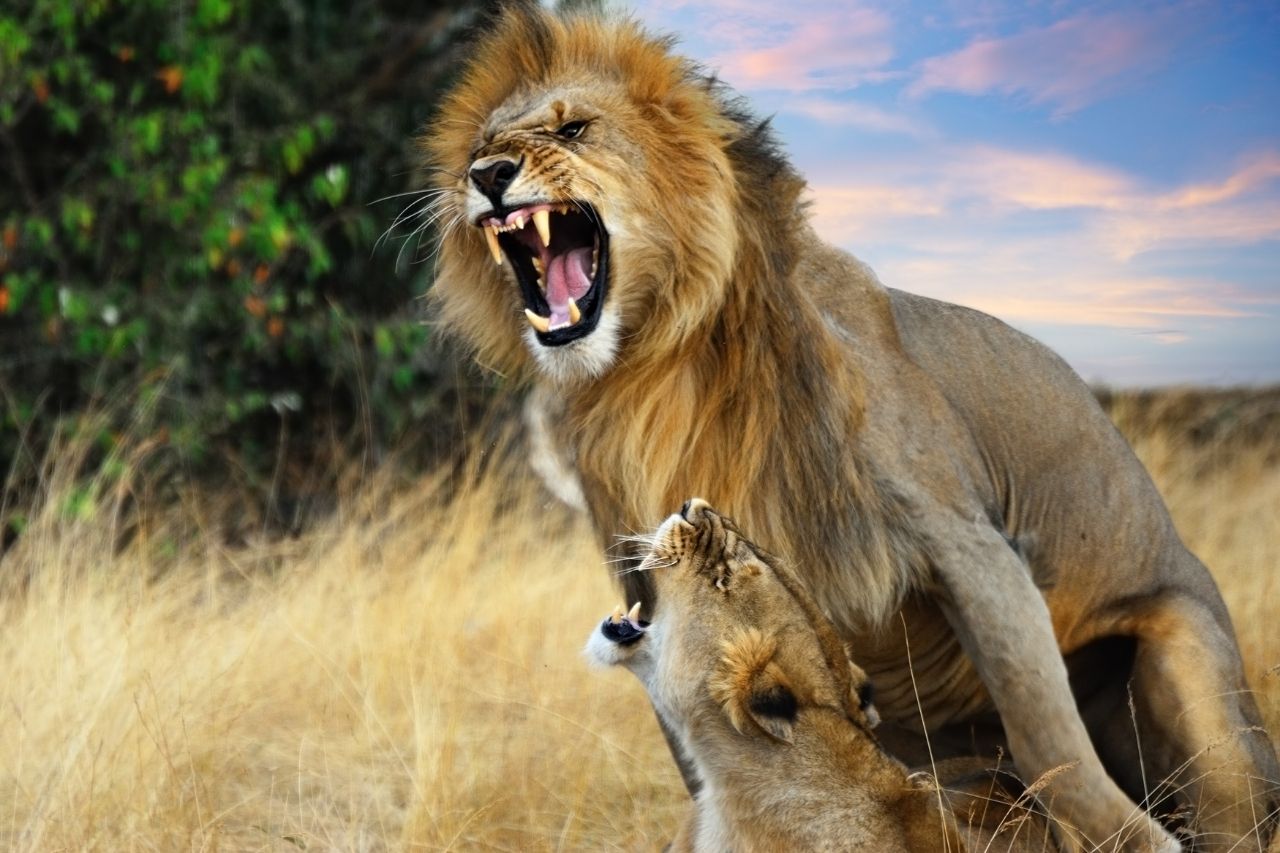
Why lions here are special
Southern Africa holds some of the world’s most resilient lion strongholds—river-fed floodplains of the Okavango, salt-pans of Etosha, basalt plains of Kruger, and the red-dune Kalahari. Across these varied habitats, lions anchor ecosystems, shape prey behavior, and captivate safari-goers with spectacles that range from river crossings to thunderous night roars. This guide gathers the essentials you need to understand lions here, plan sightings ethically, and come home with portfolio-worthy photographs.
Status & distribution in Southern Africa
- Conservation status. African lions are currently listed as Vulnerable on the IUCN Red List. The southern subspecies (Panthera leo melanochaita)—occurring in Botswana, Namibia, South Africa, Zimbabwe, Zambia and Mozambique—drives most of the continent’s remaining strongholds.
- Where they persist. Notable, well-studied populations persist in Botswana’s Okavango/Chobe system, Namibia’s Etosha and northwest, South Africa’s Kruger and Kgalagadi, Zimbabwe’s Hwange and Zambezi Valley, Zambia’s South Luangwa/Lower Zambezi/Kafue, and northern Mozambique (e.g., Niassa). Population size varies by park and year with local increases and setbacks; conservation outcomes are closely tied to protected-area management, prey abundance, and conflict mitigation around reserve edges.
- Green Status insight. Recent IUCN Green Status work characterizes lions globally as “largely depleted,” emphasizing the need to secure and reconnect strongholds—many of which are in Southern Africa.
How Southern Africa’s lions live
- Social structure. A pride usually consists of related lionesses (often ~4–6 adults) and their offspring. Adult males typically live in coalitions (commonly 2–4), competing to hold tenure over prides for 2–3 years on average.
- Hunting & activity. Lions are primarily crepuscular/nocturnal, adjusting activity with heat and moonlight. Cooperative hunting increases success on large, dangerous prey such as buffalo. On open pans and floodplains, they exploit visibility and choke points near water.
- Range size & movement. Territory and home-range sizes vary enormously with habitat and prey. Kalahari lions may roam vast, low-prey landscapes; floodplain lions track shifting water and herds.
- Cubs & turnover. After ~110-day gestation, females bear 1–4 cubs. Cub survival swings with pride stability and prey; most prides experience significant losses during male takeovers.
- The “black-maned” Kalahari look. Dark manes in the Kalahari aren’t a separate subspecies; mane color varies with age, condition and local climate.
Best places to see lions (and when)
Botswana
- Okavango Delta & Moremi. Floodplains concentrate prey and create unusual behaviors—lions traversing channels and ambushing along papyrus margins. Peak game viewing often aligns with the annual flood (roughly Jun–Aug) and the long dry season.
- Chobe (Riverfront & Savuti). Dry-season congregations of elephants and buffalo draw lions to predictable river corridors; Savuti prides are renowned for tackling large prey. May–Oct is classic.
Namibia
- Etosha National Park. In the dry winter months (May–Oct) wildlife piles into waterholes on the edge of the great pan—prime conditions for daylight lion sightings.
South Africa
- Kruger & Greater Kruger. Reliable pride territories, year-round access, and trackable morning/evening routines make Kruger a perennial favorite; the dry season (May–Oct) enhances visibility.
- Kgalagadi Transfrontier Park. Red dunes, long views, and photogenic dark-maned males reward patient, low-light work.
Zimbabwe & Zambia
- Hwange & Mana Pools (Zim); South Luangwa, Lower Zambezi & Kafue (Zam). Big, wild systems with classic lion–buffalo dynamics, especially in the dry season when prey concentrates along rivers and pans. South Luangwa’s Jul–Oct window is particularly productive.
Mozambique
- Niassa Reserve & Greater Limpopo landscape. Remote, recovering systems where lions benefit from improved anti-poaching and community conservation. (Access and conditions vary; plan with up-to-date operator advice.)
Field craft: how to find lions on safari
- Read the time of day. Pre-dawn to two hours after sunrise and the last two hours of light are most productive; mid-day lions rest in shade, often near water or on breezy knobs.
- Follow the prey. Buffalo, zebra and wildebeest herds signal lion country; in elephant-rich areas like Chobe/Savuti, lions may occasionally test juveniles during severe droughts.
- Listen. Low roars carry several kilometers, especially at night. Alarm calls (baboons, impala) and oxpecker chatter can betray a stalk.
- Let tracks lead you. Fresh pugmarks crossing roads at dawn often pay off if you parallel their direction slowly and quietly.
- Be patient with resting cats. A “sleeping” pride can become fully active as temperatures dip or as hunts develop after sunset.
Photography tips for unforgettable lion images
- Work the golden edges. Side-lit manes at sunrise/sunset add volume and detail; backlight dust for silhouette drama.
- Compose for context. Include waterholes, floodplains, or dunes to “place” the lion in Southern Africa’s distinct settings (Etosha pans, Savuti marsh, Kalahari dunes).
- Anticipate behavior. Pre-yawn stretches, cub greetings, and social rubs often repeat—pre-focus and shoot in short bursts.
- Shutter speed first. Start near 1/1000s for action; raise ISO without fear if light drops. Eye-AF helps on tight portraits; for scenes, stop down to f/5.6–f/8.
- Vehicle etiquette = sharper photos. Cut the engine, limit movement, and coordinate with your guide so everyone gets clean angles.
- Night opportunities. Some reserves allow night drives—ask for guides skilled with red filters and spotlight discipline to avoid stressing animals.
Ethical viewing & safety
- Keep distance; never crowd. Give hunting or mating lions extra space.
- No baiting or harassment—ever. Don’t request off-road approaches where prohibited, especially near cubs.
- Obey park rules (including no drones). Many parks expressly ban drones to protect wildlife and visitor safety.
Fast facts (at a glance)
- Species: Panthera leo (Southern Africa: P. l. melanochaita).
- Status: Vulnerable globally; strongholds concentrated in parts of Southern Africa.
- Social units: Prides of related females + cubs; male coalitions hold tenure.
- Hunting: Largely crepuscular/nocturnal; cooperative on big prey.
- Notable behaviors: Channel crossings in floodplains; rare, seasonal predation on juvenile/subadult elephants reported in Savuti.
Reference guide (source list)
- IUCN Red List—Panthera leo assessment and subspecies notes; global status and regional context. IUCN Red List+1
- IUCN Green Status of Species—lions characterized as “largely depleted”; restoration framing. IUCN Red List
- Okavango/Moremi lion ecology and population significance; seasonal dynamics. OpenUCT
- Lion pride composition, coalition behavior, and activity patterns. IUCN CatSG+2Panthera+2
- Kalahari ranges and black-maned coloration drivers (no unique subspecies). PubMed+1
- Kruger survey and regional monitoring insights (north of park). Endangered Wildlife Trust
- Rare elephant predation by lions in Savuti/Chobe. Taylor and Francis Online+1
- Park/region “best time to visit” references: Kruger, Chobe, Etosha, South Luangwa. SouthLuangwa.com+3Go2Africa+3Go2Africa+3
- Drone/aircraft restrictions in SANParks (applicable ethos for many SADC parks). Journals.co.za
